When you’re looking to grow your retirement savings through property investment within your Self-Managed Super Fund, understanding Loan-to-Value Ratio isn’t just a technical detail—it’s the difference between securing the deal or walking away empty-handed. Yet many SMSF trustees discover too late that the LVR limits advertised aren’t always what’s available when it’s time to sign on the dotted line.
Let me be straight with you: banks and lenders have internal policies that go far beyond what they publish on their websites. And if you don’t know what questions to ask, you might find yourself locked into terms that restrict your investment potential or, worse, unable to borrow at all.
Understanding SMSF Borrowing and LVR Basics
Limited Recourse Borrowing Arrangements allow your SMSF to borrow money to purchase a single acquirable asset—typically property—while protecting the rest of your fund’s assets if things go wrong. Under an LRBA, if your SMSF defaults on the loan, the lender can only claim the specific asset purchased with that loan, not your entire retirement savings. This structure provides crucial protection but comes with strict rules.
The Loan-to-Value Ratio represents the percentage of the property’s value that a lender is willing to finance. If you’re buying a $500,000 property with an 80% LVR, you’re borrowing $400,000 and contributing $100,000 from your SMSF’s existing balance. This ratio directly impacts how much cash your fund needs upfront, your ongoing interest costs, and your exposure to market fluctuations.
For SMSF trustees, LVR determines your leverage capacity—your ability to control a larger asset with less upfront capital. A higher LVR means less cash needed from your fund today, but it also means higher interest payments, potentially steeper monthly repayments, and greater sensitivity to property value changes. Get this calculation wrong, and you could find your fund struggling to meet loan obligations during market downturns or rental vacancy periods.
The significance goes deeper than just numbers. Your chosen LVR influences your investment diversification, your fund’s liquidity buffer, and ultimately, your retirement security. This is why understanding what lenders really offer—not just what they advertise—matters so much.

Standard LVR Norms: What the Rules Actually Say
Here’s where things get interesting. The Australian Taxation Office’s Practical Compliance Guideline PCG 2016/5 provides “safe harbour” terms for related-party Limited Recourse Borrowing Arrangements. These guidelines exist to help trustees ensure their loans are structured on arm’s length commercial terms, particularly when borrowing from related parties like family members or associated entities.
Under PCG 2016/5, the safe harbour maximum LVR for real property purchases is capped at 70% for both residential and commercial properties. For listed shares and units, the guideline suggests an even more conservative 50% LVR. These aren’t legal maximums—they’re benchmarks the ATO considers commercially reasonable for related-party arrangements to avoid triggering non-arm’s length income (NALI) provisions.
But here’s what most trustees miss: these safe harbour guidelines primarily apply to related-party loans. When you’re borrowing from an unrelated commercial lender, different rules come into play. Commercial lenders operate under their own risk assessment frameworks, and many offer LVRs up to 80% for SMSF property purchases.
For residential investment properties, the typical commercial lender range sits between 60% and 80% LVR. Commercial properties often attract slightly lower maximums, usually capping around 70% due to higher perceived risk and lower liquidity. The exact figure depends on property type, location, your SMSF’s financial position, and the lender’s current appetite for SMSF lending.
Location matters more than you’d think. A residential property in a major capital city might qualify for 80% LVR, while a similar property in a regional area might be restricted to 70% or less. Lenders assess location risk, rental yield potential, and market liquidity when setting their internal LVR caps. Properties in postcodes with declining populations or weak rental markets face tighter restrictions regardless of your fund’s financial strength.
The reality check: just because a lender advertises up to 80% LVR doesn’t mean your specific property or SMSF situation will qualify for that maximum. Each application undergoes individual assessment, and lenders have unpublished internal policies that can override advertised rates.
The High LVR Territory: When Lenders Offer More (and What It Costs)
Some lenders will approve SMSF borrowing above 80% LVR, but there’s a catch that changes the entire equation—Lenders Mortgage Insurance. When you borrow more than 80% of a property’s value, lenders see this as higher risk territory. To protect themselves, they require LMI, an insurance policy that covers the lender (not you) if you default and the property sale doesn’t recover the full loan amount.
For conventional home buyers, LMI is a standard trade-off for accessing high LVR loans. But in the SMSF context, LMI creates complications. First, the cost is substantial—typically ranging from 1% to 4% of the loan amount depending on how far you exceed 80% LVR. On a $500,000 loan at 85% LVR, you might pay $15,000 to $20,000 in LMI premiums upfront. This expense comes directly from your SMSF’s funds, immediately reducing your retirement savings.
Second, and more critically for many trustees, not all lenders offer LMI for SMSF loans. The SMSF lending market is more specialized than mainstream mortgages, and many lenders who provide residential LMI won’t extend this to Limited Recourse Borrowing Arrangements. The legal structure of an LRBA, where the lender’s recourse is limited to the specific asset, makes insurers more cautious.
At Aries Financial, we’ve seen countless trustees surprised by this reality. They assume that because high LVR loans exist in the residential market, they’re equally available for SMSF property purchases. The truth is that most SMSF lenders cap their standard offerings at 80% LVR maximum, and very few offer pathways beyond that even with LMI.
The risk management implications deserve serious consideration. Higher LVRs magnify both gains and losses. If your property increases 10% in value on an 80% LVR loan, your equity grows significantly. But if values drop 10%, you’re quickly approaching negative equity territory where your loan exceeds the property’s worth. For a retirement savings vehicle that needs long-term stability, this volatility creates genuine stress.
Borrowing costs escalate at higher LVRs beyond just LMI premiums. Interest rates often increase as LVR climbs. A lender offering 6.5% on a 70% LVR loan might charge 7.0% or more once you cross 80% LVR. Combined with LMI, your effective cost of borrowing can increase substantially—sometimes making the additional leverage not worth the financial strain.
Compliance considerations become more complex too. While there’s no specific regulatory prohibition on high LVR SMSF lending, trustees must still satisfy the sole purpose test—ensuring all investments primarily benefit members’ retirement. Excessive leverage that puts retirement savings at risk could potentially be challenged as not meeting this fundamental requirement. The ATO has increased scrutiny on SMSF lending arrangements, particularly those appearing overly aggressive or speculative.
Practical Considerations: Choosing the Right LVR for Your SMSF Investment
The question isn’t just what LVR you can get—it’s what LVR you should get. This decision shapes your fund’s financial health for years to come, influencing everything from monthly cash flow to risk exposure and ultimate retirement outcomes.
Start with your deposit size and current fund balance. An 80% LVR sounds attractive because it requires only 20% upfront contribution, but can your SMSF comfortably afford that deposit plus associated purchase costs like stamp duty, legal fees, and establishment charges? These additional costs typically add 4-6% on top of the purchase price. On a $500,000 property, you’re looking at $100,000 deposit plus $20,000-$30,000 in transaction costs—meaning your fund needs approximately $120,000-$130,000 available in liquid assets.
Borrowing costs extend well beyond the interest rate. Consider the full cost structure: loan establishment fees, ongoing account keeping fees, valuation costs, and potential break fees if you need to refinance. These accumulate quickly, and higher LVRs often come with higher fee structures. Your SMSF needs sufficient cash flow to service these ongoing costs without compromising its ability to meet other obligations or take advantage of future investment opportunities.
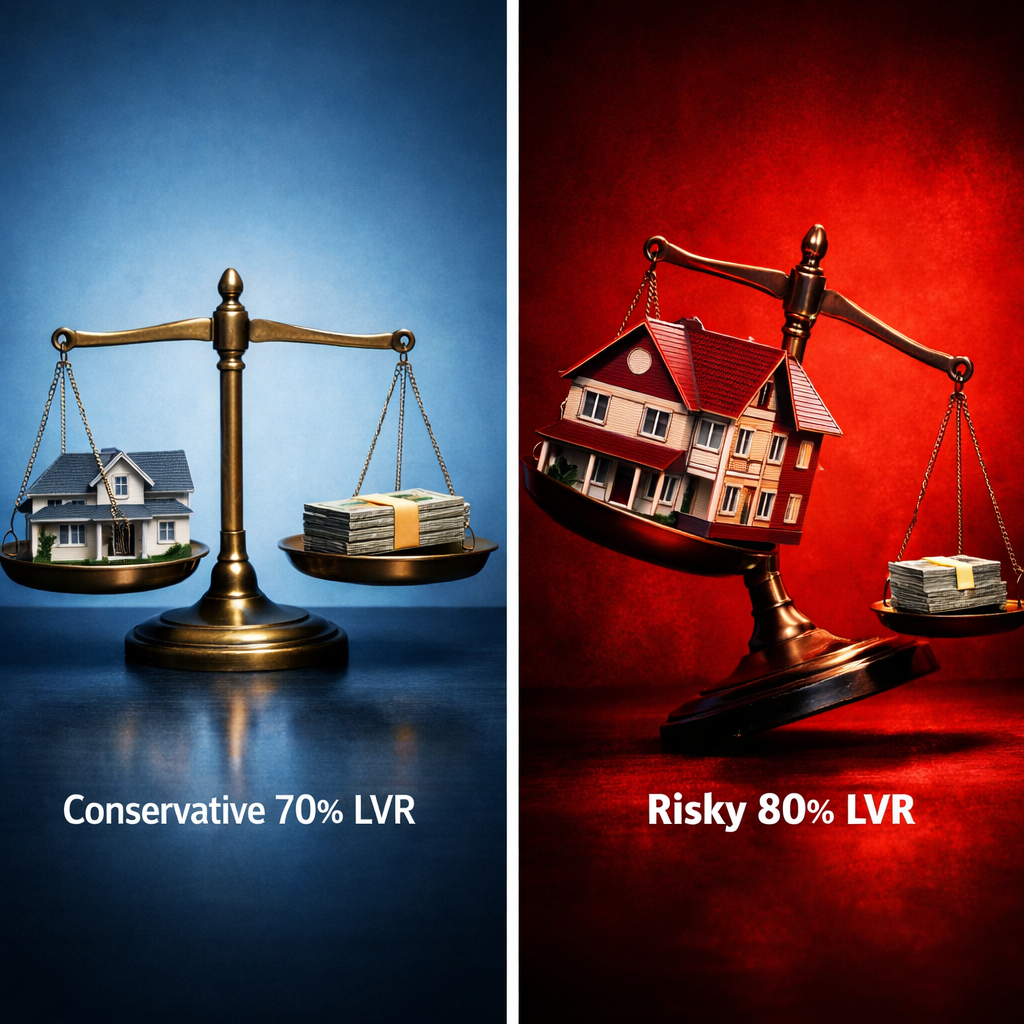
Risk exposure intensifies as LVR increases, particularly in volatile markets. Property values don’t move in straight lines—they fluctuate based on economic conditions, interest rate changes, and local market dynamics. At 70% LVR, your fund has a 30% equity buffer before facing negative equity. At 80% LVR, that buffer shrinks to 20%. During downturns like the 2008 financial crisis or 2020 pandemic, many property markets dropped 10-15%. Higher LVR borrowers found themselves underwater, unable to refinance or sell without crystallizing losses.
Rental income volatility adds another layer of risk. Your SMSF’s ability to service the loan depends largely on rental income consistency. What happens during vacancy periods, or if rental rates decline in your area? A conservative LVR provides breathing room. Your fund can absorb several months of vacancy without crisis. A high LVR leaves little margin for error—even short vacancy periods can create cash flow pressure requiring contributions from members or forcing asset sales at inopportune times.
The asset selection process should inform your LVR decision, not the other way around. Properties with strong rental yields and stable tenant demand justify higher LVRs more readily than speculative purchases in unproven locations. A well-located residential property in an established suburb with consistent rental demand presents different risk profiles than a property in an emerging area with uncertain rental markets.
Long-term viability within your SMSF structure matters immensely. Remember, this isn’t a three-year investment flip—it’s part of your retirement funding strategy through SMSF property investment. Can your SMSF maintain loan repayments through market cycles? Will your fund have sufficient liquidity to meet member benefit payments as members approach retirement? Higher LVRs lock more of your fund’s capital into servicing debt, reducing flexibility for other opportunities or meeting unexpected needs.
Consider your personal risk tolerance honestly. Some trustees sleep soundly with 80% LVR because they have stable employment, other investment assets, and capacity to make additional contributions if needed. Others find 70% or even 60% LVR provides the peace of mind necessary for long-term investing. There’s no universal right answer—only what aligns with your specific circumstances and psychological comfort level.
Quick Planning Tips for SMSF Trustees Looking to Borrow
Before approaching any lender, confirm current LVR caps specific to your intended property type and location. Don’t rely on advertised maximums—call lenders directly and ask about their actual approval rates for properties matching your criteria. The gap between advertised and approved LVRs can be surprisingly wide.
Check LMI availability and calculate its impact on your total borrowing costs. If you’re considering LVRs above 80%, get specific quotes on LMI premiums and factor these into your investment return calculations. Often, you’ll discover that a slightly lower LVR without LMI delivers better long-term returns than maximizing leverage with expensive insurance.
Ensure loan terms fit your cash flow capacity realistically. Model different scenarios: what if rental income drops 20%? What if interest rates increase 2%? Can your SMSF still meet repayments comfortably? Build buffers into your planning—assume lower rents and higher costs than projected. If the numbers still work, you’re on solid ground.
Verify compliance with LRBA rules meticulously. Even with a commercial lender, your arrangement must satisfy the Limited Recourse Borrowing requirements: single acquirable asset on a single title, held in a separate holding trust, proper documentation of the bare trust arrangement. These aren’t optional technicalities—they’re legal requirements that protect your entire SMSF structure.
Review the latest ATO guidance regularly. The regulatory landscape for SMSF lending evolves continually. Recent ATO updates have increased scrutiny on arrangements that appear designed primarily for tax benefits rather than genuine retirement savings. Ensure your borrowing strategy clearly serves your SMSF’s sole purpose of providing retirement benefits to members.
Document your decision-making process thoroughly. As trustee, you have legal obligations to make decisions in members’ best interests and keep proper records. Maintain notes explaining why you selected a particular LVR, how you assessed risks, and what alternatives you considered. This documentation protects you if the ATO ever reviews your fund’s investment decisions.
Consider professional advice before committing to significant SMSF borrowing. A specialized SMSF advisor or accountant familiar with lending arrangements can identify issues you might miss and ensure your strategy aligns with both regulatory requirements and genuine retirement planning objectives. The cost of advice is minor compared to potential consequences of non-compliance or poor investment decisions.
Building Your Retirement Future With Confidence and Clarity
Understanding SMSF borrowing LVR limits isn’t about finding loopholes or pushing boundaries—it’s about making informed decisions that genuinely serve your retirement goals. The real limit isn’t what banks won’t tell you; it’s what you haven’t asked or properly considered.
At Aries Financial, our philosophy centers on integrity, expertise, and empowerment. We believe transparency in SMSF lending means explaining not just what’s possible, but what’s appropriate for your specific situation. Too many lenders focus solely on getting deals approved without considering whether those deals truly benefit the trustee’s long-term retirement security.
Our expertise comes from specializing exclusively in SMSF lending. We understand the regulatory framework, the compliance requirements, and the practical realities of managing property investments within superannuation structures. This specialization allows us to guide trustees through complex decisions with clarity, helping you avoid common pitfalls while maximizing legitimate opportunities.
We’re committed to empowering you with knowledge and tools to make confident decisions. Whether you choose a conservative 60% LVR or push toward 80%, that choice should be informed, deliberate, and aligned with your broader retirement strategy. We provide competitive rates starting from 6.24% PI and fast approvals within 1-3 business days—not because speed is our only value, but because we’ve streamlined processes to serve informed clients efficiently.
Your SMSF represents years of disciplined saving toward financial independence in retirement. The borrowing decisions you make today echo through decades. Choose LVR levels that provide growth potential without excessive risk. Work with lenders who prioritize your long-term interests over short-term transaction volume. Maintain compliance not as a burden but as protection for everything you’ve built.
The true limit on SMSF borrowing isn’t hidden in fine print or concealed by banks. It’s determined by your fund’s financial capacity, your risk tolerance, and your commitment to genuine retirement planning over speculative gains. Understanding these boundaries empowers you to invest strategically, grow your retirement savings effectively, and maintain the peace of mind that comes from knowing your financial foundation is solid.
When you’re ready to explore SMSF property investment with a lender who values transparency and specializes in retirement-focused lending, we’re here to guide you through every decision with honesty and expertise. Your retirement deserves nothing less than clear information, fair terms, and a partner committed to your long-term success.