When you think about retirement planning, commercial property might not be the first thing that comes to mind. But for savvy Self-Managed Super Fund (SMSF) trustees, commercial property represents a powerful opportunity to build wealth through rental income and capital growth. The key to unlocking this potential lies in understanding how Limited Recourse Borrowing Arrangements (LRBAs) work and why the specific rules governing these loans fundamentally reshape your retirement investment strategy.
An SMSF is a trust structure designed to provide retirement benefits to its members. Unlike traditional superannuation funds, SMSFs give you direct control over investment decisions. This control becomes particularly valuable when combined with an LRBA, which allows your SMSF to borrow money to purchase property while protecting your fund’s other assets.
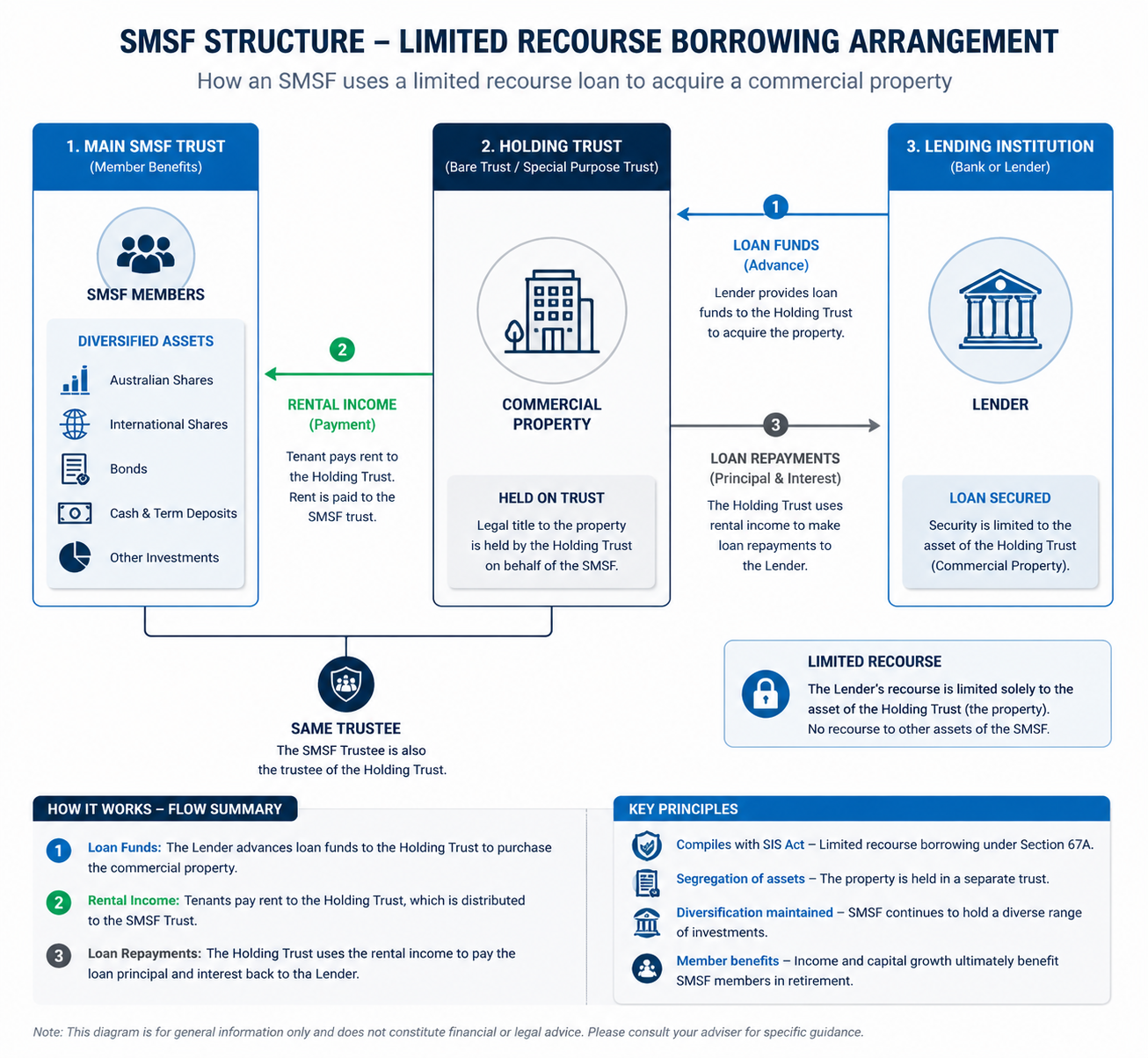
Here’s how the protection works: under an LRBA, the lender can only claim the specific property purchased with the loan if your SMSF defaults on repayments. Your fund’s shares, cash, and other investments remain completely protected. This limited recourse feature creates a firewall between the borrowed asset and everything else your SMSF owns, fundamentally changing the risk profile of property investment within superannuation.
The structure requires establishing a holding trust, separate from your SMSF, which holds the property title until the loan is fully repaid. Your SMSF becomes the beneficial owner, receiving rental income and responsible for loan repayments, while the legal ownership remains with the holding trust as security for the lender.
The Strategic Advantages of Commercial Property in Your SMSF
Commercial property offers distinct advantages over residential property when held within an SMSF. The most immediate benefit is typically higher rental yields. While residential properties might generate rental returns of 3-4% annually, commercial properties often deliver 6-8% or more, providing stronger cash flow to support loan repayments and fund operations.
Tax efficiency represents another compelling benefit. During the accumulation phase, rental income within your SMSF is taxed at just 15%, significantly lower than individual tax rates. Capital gains receive equally favorable treatment, taxed at 10% if the property is held for more than 12 months. Once your SMSF enters pension phase, both rental income and capital gains become completely tax-free.
Depreciation and interest deductions further enhance returns. Your SMSF can claim depreciation on the building and fixtures, while loan interest is fully deductible against the fund’s taxable income. These tax advantages compound over time, accelerating wealth accumulation within the superannuation environment.
Diversification also plays a crucial role. Commercial property balances your fund’s exposure across different asset classes, reducing overall portfolio volatility. While shares might fluctuate daily, commercial property typically provides stable, predictable income through longer-term leases, creating a foundation of reliability within your retirement strategy.
Macquarie’s Role in Supporting SMSF Property Strategies
Macquarie Bank has established itself as a significant player in the SMSF lending space, offering commercial property loans specifically designed for self-managed super funds. Their involvement provides trustees with access to competitive rates and professional support throughout the investment process.
What sets specialized lenders like Macquarie apart is their deep understanding of SMSF compliance requirements and superannuation law. They structure loans to align with ATO regulations, ensuring your borrowing arrangement meets all legal requirements from day one. This expertise becomes invaluable when navigating the complex intersection of property law, tax law, and superannuation legislation.
Macquarie SMSF commercial property loans typically offer loan-to-value ratios up to 70-80% for commercial assets, with loan terms extending to 30 years. This long-term financing aligns well with retirement planning horizons, allowing your SMSF to build equity gradually while benefiting from rental income and potential capital appreciation.
The bank also provides resources and guidance for managing SMSF investments, helping trustees understand their obligations and make informed decisions. This educational approach reflects a broader industry shift toward empowering SMSF trustees with knowledge rather than simply providing finance.
Understanding the Rules That Shape Your Strategy
The rules governing macquarie smsf commercial property loan arrangements aren’t just legal technicalities—they fundamentally determine what strategies work and what doesn’t. Understanding these rules transforms how you approach commercial property investment within your SMSF.
First, the LRBA must acquire a “single acquirable asset.” For commercial property, this typically means one property on one title. You cannot use a single LRBA to purchase multiple properties simultaneously, though you can establish separate LRBAs for different properties if your SMSF has sufficient capacity.
Your investment must satisfy the “sole purpose test,” meaning it exists exclusively to provide retirement benefits. This requirement creates important restrictions on related-party transactions. Your SMSF can lease commercial property to your business, but the lease must be conducted on arm’s-length terms with market-rate rent, documented agreements, and no preferential treatment.
The asset must be held in the holding trust and cannot be replaced or improved beyond minor repairs during the borrowing period. This “replacement asset” rule means you cannot use LRBA funds to develop vacant land or substantially renovate the property. The asset purchased must be the asset that eventually transfers to your SMSF once the loan is repaid.
All loan repayments must come from within the SMSF itself. You cannot make personal contributions specifically to meet loan obligations if your fund experiences cash-flow difficulties. This requirement makes cash-flow planning absolutely critical to LRBA success.
Commercial vs. Residential: Different Properties, Different Strategies
While both commercial and residential properties can be purchased through LRBAs, commercial property requires distinctly different strategic thinking. Lease structures provide the clearest example. Commercial leases typically run for five to ten years or longer, compared to residential leases of six to twelve months. This extended lease security provides predictable income, but also creates inflexibility if market conditions change.
Cash-flow profiles differ significantly. Commercial properties generally offer higher yields but may involve longer vacancy periods between tenants. Your SMSF needs sufficient liquidity to cover loan repayments during vacancies, particularly important given you cannot inject personal funds to cover shortfalls.
Tenant creditworthiness becomes paramount with commercial property. A single commercial tenant provides all your rental income, unlike residential properties where multiple tenants might share an apartment building. Due diligence on tenant financial stability isn’t optional—it’s essential to ensuring consistent loan repayment capacity.
Maintenance responsibilities also differ. Commercial leases often make tenants responsible for most property maintenance, reducing the SMSF’s operational burden. However, major structural repairs or building upgrades remain the SMSF’s responsibility, requiring careful planning for capital expenditure.
The valuation process presents another difference. Commercial property values depend heavily on lease terms and tenant quality, not just location and building characteristics. A strong tenant on a long lease commands premium pricing, while approaching lease expiry can significantly impact property value.

Critical Considerations Before Proceeding
Before committing to a macquarie smsf commercial property loan, several critical assessments demand your attention. Start with feasibility analysis. Does your SMSF have sufficient contribution capacity to support the deposit and ongoing repayments? Most lenders require 20-30% deposits for commercial property, meaning a $500,000 purchase needs $100,000-$150,000 in SMSF funds.
Consider your SMSF’s member demographics. If you’re close to retirement, a 30-year loan might not align with your superannuation strategy. Conversely, younger members with decades until retirement can leverage long-term debt to maximize property exposure and compound growth.
Structure setup requires professional advice. You’ll need proper LRBA documentation, a holding trust deed, and amendments to your SMSF trust deed ensuring it permits borrowing. These legal documents must be prepared correctly—errors can invalidate the entire arrangement and create compliance breaches.
Cost assessment extends beyond the purchase price. Factor in stamp duty, legal fees, establishment costs for the holding trust, SMSF administration expenses, property management fees, and ongoing compliance costs. These expenses can easily add 5-10% to your initial investment, affecting deposit requirements and overall returns.
Compliance alignment demands ongoing attention. Your SMSF’s investment strategy must specifically address property investment and borrowing. The strategy should document why commercial property suits your retirement goals, how it fits your risk profile, and how you’ll manage cash-flow and liquidity requirements.
Practical Implementation Steps
Successfully implementing an SMSF commercial property purchase requires methodical execution. First, ensure your SMSF is properly established with a trust deed that permits borrowing. If your SMSF is older, the trust deed may need updating to include LRBA provisions introduced in recent years.
Next, develop a comprehensive investment strategy that specifically addresses commercial property acquisition through borrowing. This strategy should detail your rationale, risk management approach, and how the property aligns with member retirement goals.
Identify suitable properties that meet both investment criteria and SMSF requirements. Remember the sole purpose test—the property must be acquired solely for retirement benefits, not personal use. If purchasing a property to lease to your business, document market comparisons proving the rent represents arm’s-length terms.
Arrange pre-approval from specialized SMSF lenders like Macquarie. Pre-approval clarifies borrowing capacity and loan terms before you commit to a specific property, protecting you from making offers on properties your SMSF cannot finance.
Establish the holding trust structure before settlement. The holding trust, not your SMSF, must appear on the property title as legal owner. Your solicitor should prepare all documentation ensuring the structure meets ATO requirements.
Complete due diligence thoroughly. Obtain professional valuations, building inspections, and review lease agreements carefully. For commercial property, also review tenant financial information and understand lease renewal options.
After settlement, maintain meticulous records. Document all rent received, expenses paid, and loan repayments made. Regular SMSF audits will examine these transactions, ensuring compliance with superannuation law and LRBA requirements.
Monitor cash-flow continuously. Establish systems ensuring rental income flows to your SMSF, loan repayments are made on time, and sufficient liquidity exists for unexpected expenses. Many SMSF failures stem from cash-flow management issues, not poor property selection.
Managing the Risks Inherent in SMSF Property Investment
Every investment carries risk, but LRBA commercial property investment creates specific risks requiring active management. Cash-flow risk tops the list. If your tenant vacates or defaults on rent, your SMSF must still meet loan repayments from other fund resources. Build a cash buffer within your SMSF equivalent to six to twelve months of loan repayments.
Market risk affects both property values and rental rates. Commercial property markets can experience prolonged downturns, potentially leaving your SMSF with an asset worth less than the outstanding loan. Careful property selection in strong locations with diverse tenant demand helps mitigate this risk.
Regulatory risk remains ever-present. Superannuation laws change regularly, and LRBA rules could be modified or restricted in the future. Stay informed about regulatory developments and work with advisors who monitor legislative changes affecting SMSF property investment.
Liquidity risk becomes particularly acute with commercial property. Unlike shares, which can be sold quickly, commercial property may take months or years to sell, especially during market downturns. Your SMSF needs sufficient liquid assets to manage ongoing obligations without forced property sales.
Tenant concentration risk creates vulnerability. A single commercial tenant provides all rental income, meaning tenant financial difficulties directly impact your SMSF’s ability to service debt. Conduct thorough tenant due diligence and consider requiring bank guarantees for significant leases.
Interest rate risk affects loan affordability. Even with fixed-rate periods, rates eventually revert to variable, potentially increasing repayment obligations. Stress-test your SMSF’s capacity to handle interest rate increases of 2-3% above current levels.
Effective risk management requires diversification beyond property. Maintain investments in shares, bonds, and cash alongside property holdings. This diversification provides income sources if property rental income ceases and creates options for portfolio rebalancing when needed.
Quick Overview: The LRBA Commercial Property Opportunity
For SMSF trustees seeking to leverage retirement savings into income-producing assets, commercial property through an LRBA represents a proven wealth-building strategy. The structure’s limited recourse nature protects your fund’s other assets while allowing access to larger property investments than cash alone would permit.
The advantages are clear: higher rental yields than residential property, significant tax benefits during accumulation and pension phases, portfolio diversification, and potential for long-term capital growth. Macquarie’s specialized SMSF lending products provide the financial tools to implement this strategy with professional support throughout the process.
However, success requires understanding and following strict compliance rules, maintaining adequate cash flow, and managing inherent risks through proper planning and diversification. The sole purpose test, related-party restrictions, and single acquirable asset requirements aren’t obstacles but rather guidelines ensuring your investment serves its intended purpose: providing retirement benefits.
With proper structure, professional advice, and disciplined management, commercial property can become a cornerstone of your retirement wealth strategy, generating tax-advantaged income today while building capital for tomorrow.
Final Thoughts on Building Retirement Wealth Through Commercial Property
The intersection of SMSF rules, LRBA mechanics, and commercial property investment creates both opportunity and complexity. Understanding how these elements work together transforms commercial property from a confusing option into a strategic retirement planning tool.
The rules aren’t arbitrary restrictions—they’re safeguards ensuring borrowed funds genuinely serve retirement purposes while protecting both fund members and the superannuation system. By aligning your investment decisions with these rules rather than viewing them as obstacles, you create sustainable strategies that withstand regulatory scrutiny and market challenges.
Choose experienced lenders who understand SMSF compliance and can guide you through the process. Macquarie and specialized SMSF lenders bring expertise that prevents costly mistakes and ensures your borrowing arrangement is structured correctly from the start.
Most importantly, remember that a macquarie smsf commercial property loan is a tool, not a guarantee. Like any tool, its effectiveness depends on how you use it. Match property selection to your SMSF’s specific circumstances, maintain conservative cash flow buffers, and never let borrowing capacity exceed your fund’s genuine ability to service debt through normal operations.
Commercial property investment through your SMSF represents a long-term commitment requiring ongoing attention and management. But for trustees willing to understand the rules, maintain compliance, and think strategically about retirement wealth building, it offers a pathway to tax-effective income and capital growth that few other investment strategies can match.