Property investment through your self-managed super fund sounds like a brilliant wealth-building strategy. And it is—until you hit an unexpected regulatory wall that stops your deal in its tracks.
Most SMSF trustees understand the basics of borrowing through their fund. They know about limited recourse borrowing arrangements. They’ve heard about the single acquirable asset rule. But there’s one critical ATO requirement that catches even experienced investors off guard: the 10% limit that could determine whether your next property purchase goes ahead or gets shelved indefinitely.
This isn’t about complex legal technicalities or obscure tax provisions. This is a practical constraint that affects real property deals, real retirement plans, and real financial outcomes. And if you’re planning to leverage your SMSF to acquire property, understanding this rule isn’t optional—it’s essential.
Understanding Limited Recourse Borrowing Arrangements: Your Gateway to SMSF Property Investment
Before we dive into the 10% rule, let’s establish what makes SMSF borrowing unique. Unlike traditional property loans, SMSFs can only borrow money through a specific structure called a Limited Recourse Borrowing Arrangement, or LRBA.
An LRBA allows your SMSF to borrow funds to purchase a single asset—typically property—while protecting the fund’s other assets from potential lender claims. If something goes wrong and the loan defaults, the lender’s recourse is limited to the specific asset purchased with the borrowed funds. Your other SMSF investments remain protected.
This protection exists for good reason. Your super fund holds your retirement savings, and the law recognizes these savings deserve extra safeguarding. The LRBA structure achieves this balance: it enables strategic property investment while maintaining risk boundaries.
For SMSF trustees, LRBAs have become increasingly popular for several compelling reasons. First, they allow you to leverage your existing super balance to acquire higher-value properties than you could purchase outright. Instead of waiting years to accumulate enough cash, you can enter the property market now, benefiting from potential capital growth and rental income during those crucial accumulation years.
Second, property acquired through an LRBA generates rental income within your SMSF’s concessional tax environment. During accumulation phase, this income is taxed at just 15%, compared to your marginal tax rate outside super. In pension phase, it may be tax-free entirely.
Third, an LRBA creates diversification within your retirement portfolio. Rather than holding everything in shares or cash, you’re adding a tangible, income-producing asset that historically appreciates over time.
But here’s the catch: LRBAs come with strict compliance requirements. The ATO doesn’t hand out borrowing privileges lightly. These arrangements must meet specific conditions under the Superannuation Industry (Supervision) Act 1993, and trustees who breach these rules face penalties that can include fines, disqualification, or even the fund losing its complying status.
One such condition revolves around the amount you can borrow and the reserves you must maintain. This is where many trustees encounter their first major hurdle.
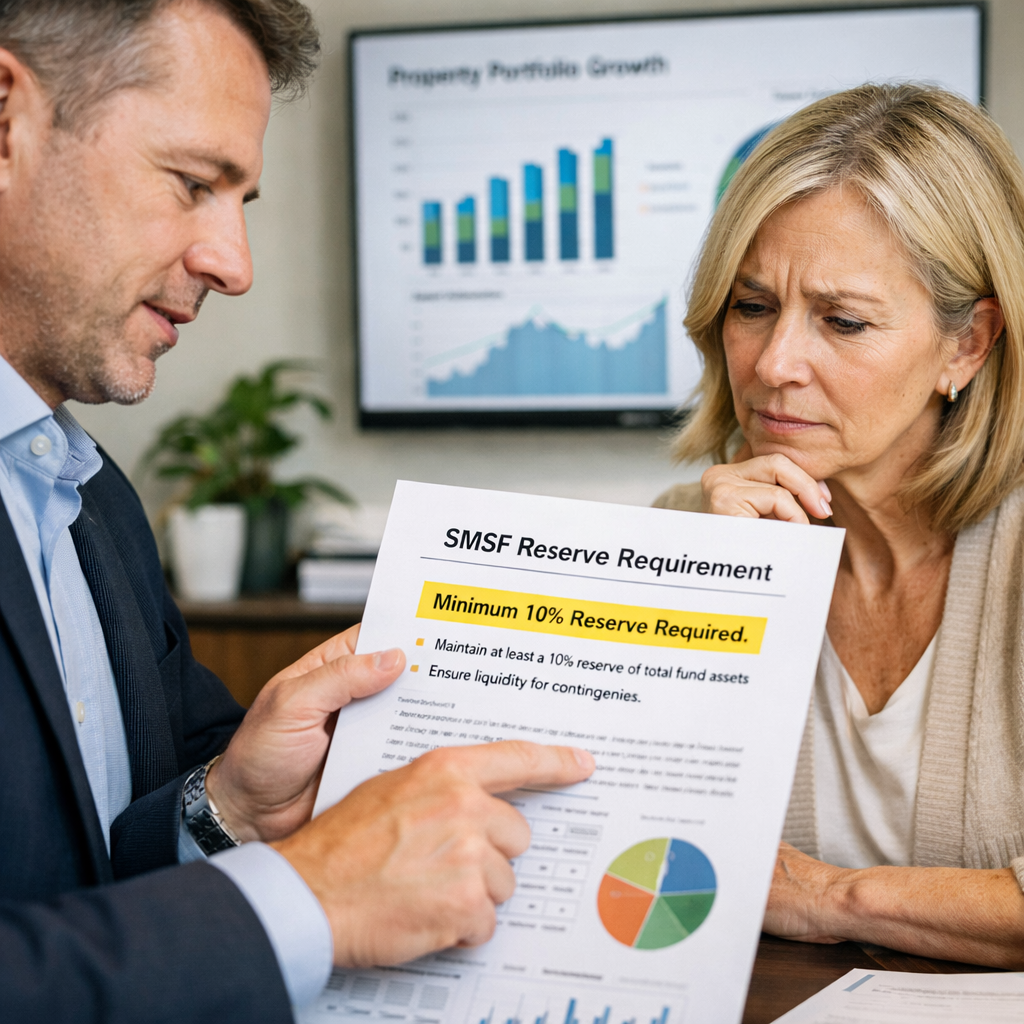
The 10% Rule: The Reserve Requirement That Stops Deals Cold
Here’s the rule that catches trustees unprepared: when borrowing through an LRBA, most lenders require your SMSF to maintain liquid reserves equal to at least 10% of the property’s purchase price after settlement.
Let’s put this in real terms. Imagine you’ve found the perfect investment property valued at $600,000. Your SMSF has $250,000 in total assets. You’re planning to borrow $420,000 (70% LVR, which is standard for SMSF loans), contribute $180,000 as a deposit, and use the remaining $70,000 to cover stamp duty, legal fees, and other acquisition costs.
On paper, this looks workable. You have enough for the deposit and costs. The loan-to-value ratio meets lender requirements. But here’s what stops this deal: after settlement, your SMSF needs to retain $60,000 in liquid reserves (10% of $600,000). Your fund would be left with zero buffer, breaching the lender’s reserve requirement.
This isn’t an arbitrary bank policy. Lenders impose this requirement because SMSF property investments come with ongoing obligations. Your fund needs to cover loan repayments, property management fees, council rates, insurance, maintenance, and potential vacancy periods. Without adequate liquid reserves, your fund could quickly become unable to meet these obligations, forcing a distressed sale.
The ATO itself recognizes the need for liquidity within SMSFs. While the regulator doesn’t mandate a specific 10% reserve for LRBAs, it does allow funds to borrow up to 10% of total asset value for up to 90 days to meet short-term liquidity needs. This provision exists precisely because super funds can face temporary cash flow pressures.
Beyond lender requirements, there’s another critical 10% consideration: most lenders require minimum SMSF balances post-settlement ranging from $150,000 to $250,000. This ensures your fund maintains sufficient working capital even after acquiring the property and covering all associated costs.
The implications of these rules are profound. They effectively create a minimum fund size threshold for SMSF property investment. If your fund holds $200,000 and you want to buy a $500,000 property with a 70% LVR, you’ll need $150,000 for the deposit, approximately $30,000 for acquisition costs, and $50,000 in reserves—totaling $230,000. Your deal doesn’t work.
Many trustees discover this reality only after they’ve found their ideal property, engaged conveyancers, and spent time and money on due diligence. The emotional and financial cost of abandoned deals adds up quickly.
Understanding these limits before you start property hunting saves frustration, wasted effort, and missed opportunities. It allows you to set realistic investment targets aligned with your fund’s actual capacity.
Setting Up an LRBA: The Two-Trust Structure and Compliance Imperatives
If your SMSF has sufficient assets to meet reserve requirements, the next step involves establishing the proper structure for your LRBA. This isn’t as simple as walking into a bank and applying for a loan. SMSF borrowing requires a specific two-trust structure mandated by superannuation law.
Here’s how it works: when your SMSF borrows to purchase property, the asset cannot be held directly in the fund’s name during the loan period. Instead, it must be held in a separate holding trust, sometimes called a bare trust or custodian trust. Your SMSF becomes the beneficiary of this holding trust, while a custodian (typically the SMSF trustee or a corporate trustee) holds legal title to the property.
This arrangement ensures the lender’s recourse is limited to the specific property, protecting your SMSF’s other assets as required by law. Once the loan is fully repaid, the property transfers from the holding trust directly into the SMSF’s name.
Establishing this structure requires professional legal assistance. The trust deed for the holding trust must comply precisely with ATO requirements. Any deviation from the prescribed format can render your LRBA non-compliant, potentially triggering penalties or forcing you to unwind the arrangement.
Beyond structure, your LRBA must satisfy several ongoing compliance requirements. The property must be a “single acquirable asset“—generally, one residential property, one commercial property, or a collection of identical shares. You cannot use one LRBA to purchase multiple different properties simultaneously.
The asset must be maintained in its original form. While minor improvements are allowed, you cannot fundamentally alter the asset’s character. For example, if you purchase a house, you cannot demolish it and build units during the loan period. Such changes would breach the single acquirable asset rule.
Your SMSF’s investment strategy must document the decision to enter the LRBA, outlining how it aligns with the fund’s retirement objectives and risk profile. This document isn’t optional—it’s a legal requirement that auditors review annually.
Interest rates on SMSF loans must meet arm’s length standards. If you’re borrowing from a related party (which is permitted under strict conditions), the ATO scrutinizes the interest rate to ensure it reflects genuine commercial terms. Using rates below market value can trigger Non-Arm’s Length Income (NALI) rules, causing your SMSF’s income to be taxed at the highest marginal rate rather than the concessional 15% rate.
At Aries Financial, we’ve observed that successful SMSF property investors share one common trait: they seek expert guidance before committing to a purchase. They understand that SMSF lending operates in a specialized regulatory environment where mistakes carry serious consequences. These investors prioritize compliance not because it’s burdensome, but because it protects their retirement security.
This approach reflects a core principle at Aries Financial: integrity in every transaction. SMSF lending isn’t about cutting corners or finding loopholes. It’s about working within the regulatory framework to achieve legitimate investment goals that build long-term wealth.
When trustees approach SMSF borrowing with transparency and proper professional support, they’re not just buying property—they’re building a secure financial foundation for retirement. They’re making informed decisions based on complete understanding of both opportunities and constraints.
The trustees who thrive in SMSF property investment are those who view compliance as an enabler rather than an obstacle. They recognize that the rules exist to protect their interests, ensuring their retirement savings remain secure even when market conditions shift or unexpected challenges emerge.

Building Retirement Wealth Through Strategic SMSF Property Investment
The 10% reserve rule and other LRBA compliance requirements might seem restrictive at first glance. But these guardrails serve an important purpose: they ensure SMSF property investment remains a wealth-building strategy rather than a source of financial stress.
When approached strategically, an LRBA enables you to acquire quality investment property that would otherwise remain out of reach. Consider the long-term impact: a well-selected property purchased through your SMSF today could deliver decades of rental income and capital growth, all within a tax-effective environment. By the time you enter pension phase, that property could be generating tax-free income supporting your retirement lifestyle.
The key is entering these arrangements with realistic expectations and adequate preparation. Before pursuing SMSF property investment, assess your fund’s total position honestly. Calculate not just your deposit and costs, but your post-settlement reserves. Factor in an additional buffer for unexpected expenses—properties always cost more than initial projections.
Consider your fund’s cash flow carefully. How much does your SMSF receive in contributions each year? Will rental income cover loan repayments, or will you need to supplement from other sources? Can your fund maintain required reserves even during vacancy periods?
These questions aren’t meant to discourage SMSF borrowing. They’re designed to ensure your investment succeeds. Trustees who thoroughly analyze their fund’s capacity before purchasing property rarely face compliance issues or financial strain. They’ve planned for contingencies, maintained appropriate buffers, and structured their affairs to withstand normal market fluctuations.
This is where working with specialists makes a tangible difference. At Aries Financial, we understand that every SMSF situation is unique. We don’t offer one-size-fits-all solutions because your fund’s circumstances, goals, and capacity differ from every other trustee’s.
Our role is to help you understand what’s possible given your specific position. We provide competitive SMSF loan solutions starting from 6.24% PI, but more importantly, we offer expertise that empowers you to make decisions aligned with your retirement objectives. We explain the reserve requirements upfront, discuss realistic property price ranges for your fund’s size, and outline the compliance obligations you’ll need to meet.
This approach reflects our commitment to empowerment through knowledge. We believe informed investors make better decisions. When you understand not just what you can borrow but why these rules exist and how they protect your interests, you approach SMSF property investment with confidence rather than anxiety.
The trustees who succeed in building retirement wealth through property share another common characteristic: they work with partners who prioritize their long-term success over short-term transactions. They choose advisors and lenders who take time to explain, educate, and guide rather than simply process applications.
This relationship-based approach delivers results. When trustees feel supported by knowledgeable partners, they’re more likely to maintain compliance, make strategic decisions, and achieve their retirement goals. They view their SMSF as a long-term wealth-building vehicle rather than a short-term speculation opportunity.
As Australia’s trusted SMSF lending specialist, Aries Financial has built its reputation on exactly this foundation. We provide fast approvals—often within 1-3 business days—because we understand property opportunities don’t wait. But speed never comes at the expense of thoroughness. We ensure every LRBA we facilitate meets ATO requirements and positions our clients for long-term success.
Whether you’re a first-time SMSF property investor or an experienced trustee expanding your portfolio, the principles remain constant. Understand the rules, particularly the often-overlooked 10% reserve requirement. Ensure your fund has adequate capacity before committing to a purchase. Establish proper structures with professional guidance. Maintain transparency and integrity throughout the investment lifecycle.
These aren’t just compliance checkboxes. They’re the foundation of successful SMSF property investment. They’re what separates sustainable wealth-building from risky speculation. And they’re what ensures your super fund fulfills its ultimate purpose: providing financial security in retirement.
The path to retirement wealth through SMSF property investment is well-established. Thousands of Australian trustees have successfully navigated LRBA compliance, acquired quality properties, and built substantial retirement portfolios. The opportunity is real, the framework is clear, and the support is available. What matters most is approaching this strategy with the right knowledge, realistic expectations, and trusted partners by your side.