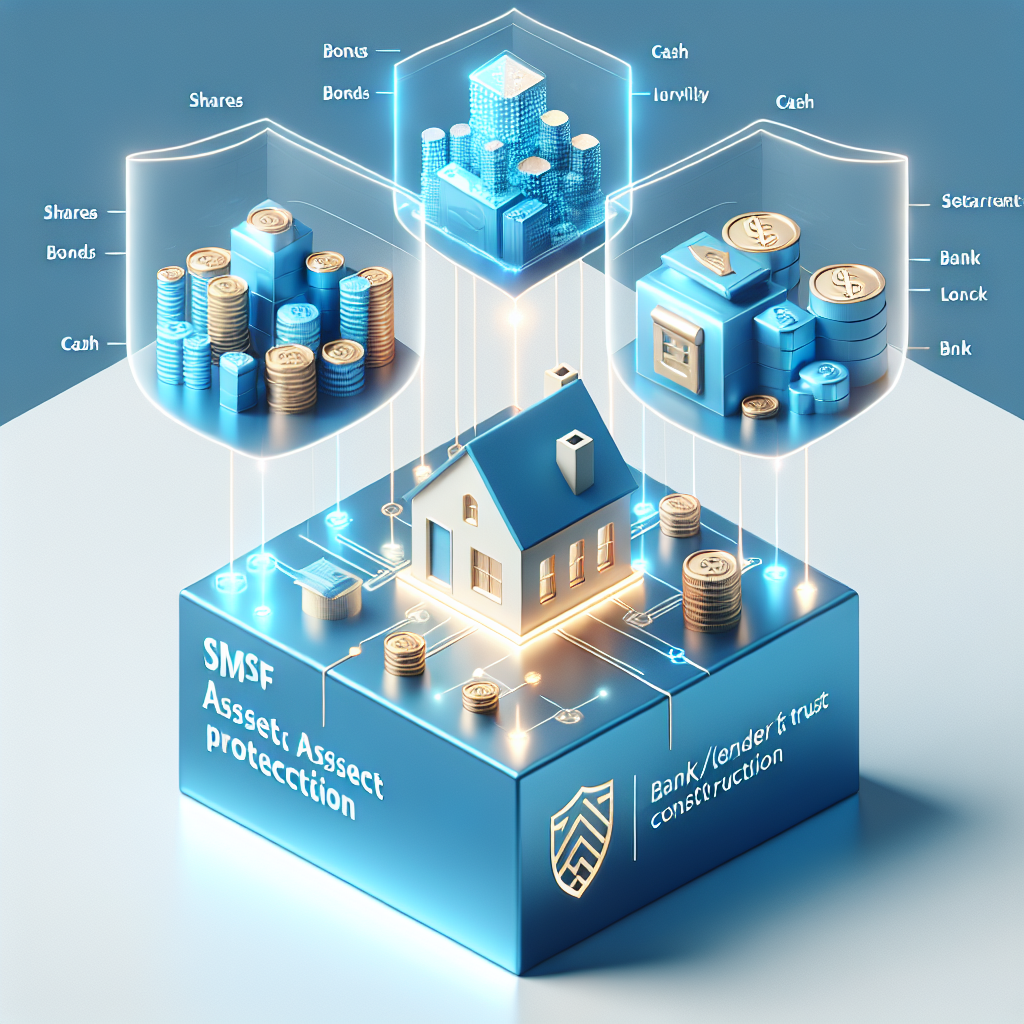
When you use your Self-Managed Super Fund to buy property, you’re making one of the biggest financial decisions of your retirement planning journey. A Limited Recourse Borrowing Arrangement (LRBA) lets your SMSF borrow money to purchase an asset—typically real estate—while protecting your fund from excessive risk. The key feature? If things go wrong, the lender can only claim the asset itself, not your entire super balance.
But here’s the critical question many SMSF trustees overlook: Are you paying too much interest on your LRBA?
The structure works like this: your SMSF trustee obtains a loan from a third-party lender to purchase an acquirable asset. That asset is held in a separate trust—called a bare trust—distinct from your SMSF. This separation is what creates the “limited recourse” protection. The lender’s rights extend only to the asset held in the bare trust, not to other SMSF assets.
Before you jump into an LRBA, you need to ensure the investment aligns with your fund’s investment strategy. Your SMSF’s trust deed must permit borrowing, and the asset must genuinely contribute to your retirement objectives. Property investment through your super can be powerful, but it carries real risks: market downturns, tenant vacancies, maintenance costs, and the ongoing obligation to service the loan regardless of rental income fluctuations.
The ATO watches these arrangements carefully. They want to ensure that related-party LRBAs—where you borrow from a related entity rather than a commercial lender—are conducted on arm’s length terms. If they determine your loan terms aren’t commercial, you could face Non-Arm’s Length Income (NALI) consequences, taxing affected income at the top marginal rate of 45% instead of the concessional super rate. That’s a costly mistake no trustee wants to make.

Why Interest Rates Matter More Than You Think
Interest rates aren’t just a number on your loan documents. They’re the single biggest factor determining whether your SMSF property investment succeeds or struggles.
Think about it this way: every dollar you pay in interest reduces the after-tax cash flow available to your fund. Unlike homeowners who might claim tax deductions on investment property interest, your SMSF operates in a low-tax environment—paying just 15% on income in accumulation phase or zero in pension phase. This means interest costs hit harder because there’s less tax relief.
Let’s look at a real example. Suppose your SMSF borrows $500,000 through an LRBA to purchase a commercial property. At an interest rate of 6.94% per annum, you’ll pay approximately $34,700 in interest annually. But if you’re unknowingly paying 9.35%—perhaps because you established a related-party LRBA and set the rate too high—your annual interest jumps to $46,750. That’s an extra $12,050 per year flowing out of your fund. Over a typical 15-year loan term, that’s $180,750 in unnecessary costs.
Can your fund service those repayments? This question keeps many SMSF trustees awake at night. Your fund needs reliable income—whether from rental yields, contributions, or other investments—to meet loan obligations. If rental income drops due to vacancy or your contributions are limited due to contribution caps, cash flow pressure builds quickly.
Beyond interest rates, lender terms matter enormously. Origination fees, ongoing loan administration charges, valuation costs, and early repayment penalties all chip away at your investment returns. Some lenders advertise attractive interest rates but load up on fees. Others offer more flexible terms that better suit SMSF cash flow patterns.
This is where the ATO’s safe harbour rates become your guideline. These rates represent the ATO’s view of what constitutes arm’s length interest rates for related-party LRBAs. If your arrangement falls within these parameters, you have strong evidence that your loan terms are commercial. Stray significantly above these rates without good reason, and you’re inviting scrutiny.
Understanding Safe Harbour Rates: Your Compliance Benchmark
For the 2025–26 financial year, the ATO has set safe harbour interest rates at:
- 8.95% for LRBAs used to acquire real property (down from 9.35% in 2024–25)
- 10.95% for LRBAs used to acquire listed securities and other non-real property assets (down from 11.35% in 2024–25)
These rates reflect current market conditions and the Reserve Bank’s monetary policy stance. The reduction from the previous year signals that the ATO recognizes the easing in some lending markets, though rates remain elevated compared to the ultra-low environment of 2020–2022.
Here’s what you need to understand: these safe harbour rates can fluctuate significantly year over year. Back in 2022–23, when interest rates were climbing rapidly, the safe harbour rate for real property LRBAs jumped from 5.35% to 8.85% in a single year. That’s a massive 350 basis point increase that caught many trustees off guard.
The safe harbour provision allows for one important flexibility: you can fix the interest rate at the start of the LRBA for up to five years for real property acquisitions and up to three years for listed securities. This means if you established your LRBA in 2021 when rates were around 5%, you could maintain that rate until 2026, even as safe harbour rates climbed. This protection prevents your related-party loan from falling outside safe harbour parameters simply due to market movements beyond your control.
But here’s the practical reality: if you’re establishing a new LRBA in 2025–26, you need to benchmark against the current 8.95% rate for property. If you’re borrowing from a related party and charging significantly less—say 6%—the ATO might view this as a non-commercial arrangement, triggering NALI consequences. Conversely, if you’re charging yourself 12% when the safe harbour is 8.95%, you’re unnecessarily draining your fund’s resources.
The historical trend tells an important story. From 2016 through 2021, safe harbour rates hovered between 5% and 6% as the RBA maintained historically low cash rates. The sharp increases in 2022–2024 reflected the aggressive rate hiking cycle. Now, as rates stabilize and potentially edge downward, we’re seeing modest reductions. Smart trustees monitor these trends and adjust their arrangements accordingly.
Conducting a True Cost Analysis
Using safe harbour rates isn’t just about compliance—it’s about understanding the true cost of your SMSF property investment.
Start by comparing your actual loan terms against the current safe harbour benchmarks. If your SMSF has a related-party LRBA charging 9.5% interest on a property acquisition, you’re above the 8.95% safe harbour rate. While you might have valid commercial reasons for this, you need documentation proving why market conditions or the asset’s risk profile justify the premium.
Remember, the safe harbour rates assume certain loan parameters outlined in Practical Compliance Guideline PCG 2016/5. For real property LRBAs, this includes a maximum loan-to-value ratio (LVR) of 70%, with all loans combined not exceeding this threshold. If you’re borrowing at a higher LVR, commercial lenders would typically charge a premium, and the safe harbour rate might not fully protect you.
Beyond interest rates, factor in all related costs:
Origination and establishment fees typically range from 1% to 2% of the loan amount. On a $500,000 LRBA, that’s $5,000 to $10,000 upfront.
Ongoing administration fees might run $300 to $600 annually. While seemingly small, these compound over the life of your loan.
Property-related costs including maintenance, insurance, council rates, strata fees, and property management charges all reduce your net return. A property generating $30,000 in annual rent might have $8,000 to $12,000 in ongoing costs.
Bare trust establishment and maintenance fees add another layer of expense, often $800 to $1,500 initially and $300 to $500 annually.
Now evaluate the after-tax impact. If your SMSF is in accumulation phase, investment income is taxed at 15%. Capital gains on assets held more than 12 months receive a one-third discount, resulting in an effective 10% tax rate. In pension phase, investment income is tax-free. This tax treatment means every dollar of expense genuinely costs close to a full dollar, unlike negatively geared property investments outside super where tax deductions offset up to 47% of costs.
Cash flow viability requires honest assessment. Your SMSF needs sufficient liquidity to cover loan repayments, property expenses, and SMSF operating costs without compromising diversification or breaching liquidity requirements. A property returning 4% gross yield (common for many commercial properties) needs substantial equity or supplementary income to service a loan at 8.95%.
Consider this scenario: You borrow $400,000 at 8.95% interest-only to purchase a $600,000 commercial property. Annual interest is $35,800. The property generates $28,000 in rent ($600,000 × 4.67% yield). After property expenses of $4,000, you’re $11,800 short annually. You’ll need to cover this gap from member contributions, other SMSF income, or existing cash reserves. Can your fund sustain this for years until rental income grows or you switch to pension phase?

Practical Guidance for SMSF Trustees
If you’re considering an LRBA or currently have one in place, here’s your action plan:
Document everything meticulously. For related-party loans, maintain comprehensive written agreements covering loan amount, interest rate, repayment terms, security arrangements, and default provisions. The ATO will expect to see evidence that you’ve considered commercial factors and established arm’s length terms. Include board minutes showing trustee deliberations and the rationale for chosen terms.
Review arrangements regularly. Market conditions change. The interest rate that seemed reasonable three years ago might be uncompetitive today. While you’re not required to constantly adjust rates within the safe harbour five-year fixing period, periodic reviews ensure your arrangements remain appropriate. If you’re significantly overpaying relative to market rates, consider refinancing—but be aware of any break fees or establishment costs that might offset benefits.
Monitor safe harbour rate updates annually. The ATO typically publishes updated rates mid-year for the upcoming financial year. Set a reminder each June to check the new rates and assess whether your arrangement remains within safe harbour parameters. This proactive approach prevents nasty surprises during audits.
Align LRBA terms with your fund’s investment strategy and risk tolerance. Your SMSF’s investment strategy should explicitly address borrowing, including the rationale for using an LRBA, target asset classes, maximum borrowing limits, and how borrowed assets fit within overall portfolio diversification. If your strategy emphasizes capital preservation and conservative investments, an aggressive LRBA might not align.
Consider professional advice from SMSF specialists. The interplay between superannuation law, tax rules, property regulations, and lending requirements creates complexity that challenges even sophisticated trustees. SMSF-specialist accountants, financial advisors, and legal professionals help navigate these waters while maximizing returns and minimizing risks.
At Aries Financial, we’ve seen countless trustees benefit from expert guidance on LRBA structuring. Our focus on SMSF lending compliance and competitive rates starting from 6.24% for principal and interest loans means you’re not overpaying for your super property investment. We understand that every dollar counts in building your retirement wealth, which is why we prioritize transparency and education alongside competitive pricing.
Stress-test your assumptions. What happens if interest rates rise another 2%? What if your property sits vacant for six months? What if major repairs cost $20,000? Running scenarios helps you understand your fund’s resilience and whether your LRBA is sustainable under adverse conditions.
Quick Takeaways for Your SMSF Journey
Limited Recourse Borrowing Arrangements offer powerful opportunities for SMSF trustees to leverage retirement savings into property investments. But the interest rate you pay dramatically impacts whether this strategy builds wealth or drains resources.
The ATO’s safe harbour rates—currently 8.95% for real property and 10.95% for listed securities in 2025–26—provide crucial benchmarks for ensuring your related-party LRBA remains compliant. These rates can shift significantly year to year, reflecting broader economic conditions, so annual reviews are essential.
But safe harbour compliance is just the starting point. True cost-effectiveness requires analyzing all loan terms, fees, and property expenses to understand your investment’s genuine impact on retirement outcomes. The after-tax cash flow, not just the headline interest rate, determines whether your SMSF can comfortably service the arrangement.
Remember these key points:
- Document your LRBA thoroughly with written agreements reflecting arm’s length terms
- Compare your actual rate against current safe harbour benchmarks annually
- Factor in all costs beyond interest, including fees, property expenses, and tax implications
- Ensure your fund has reliable cash flow to service repayments under various scenarios
- Align borrowing decisions with your fund’s investment strategy and risk tolerance
The philosophy that guides Aries Financial emphasizes integrity, expertise, and empowerment in SMSF lending. We believe trustees deserve transparent information, competitive pricing, and guidance that puts their retirement goals first. Whether you’re exploring your first SMSF property purchase or refinancing an existing arrangement, understanding the true cost of your borrowing ensures you’re maximizing your fund’s potential rather than overpaying for the privilege.
Your super is too important to leave interest rates to chance. Take the time to understand what you’re paying, why you’re paying it, and whether there’s a better path forward. With the right approach and the right lending partner, an LRBA can be a powerful tool for building the retirement you deserve.